
by Tim Cronin
Public transportation is a greener alternative to commuting by car, but we need a functioning MBTA that works for Weymouth residents in order to reduce our town’s transportation emissions.
In Massachusetts, the largest percentage of carbon pollution come from the transportation sector. Alone these emissions represent 39% of all greenhouse gas emissions from the state. And the majority of these emissions come from personal car use.
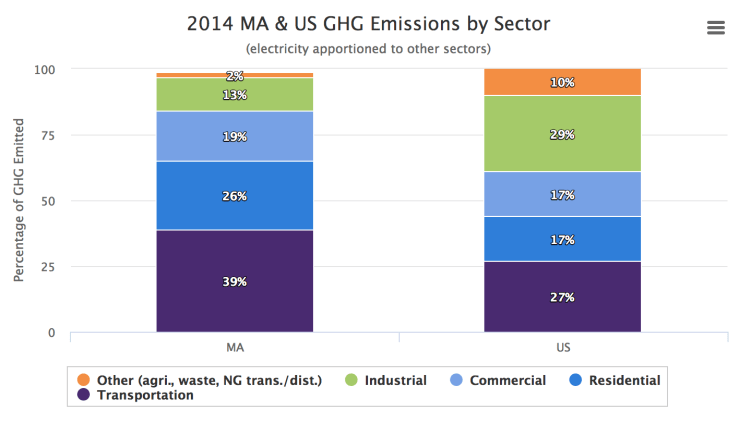 [Source: Executive Office of Energy and Environmental Affairs]
Any serious effort to reduce carbon emissions in Weymouth or greater Massachusetts would require tackling those coming from the transportation sector. The best alternative to commuting by car is to take public transportation. Doing so significantly reduces an individual’s carbon footprint, and helps chips away at the state’s overall transportation emissions.
In Weymouth we’re fortunate to have two commuter rail lines, multiple bus routes, and we’re in close proximity to the ferry service and redline. This all means that it is theoretically easy to use the MBTA to commute into Boston regularly. Yet public transportation only works as a greener, viable alternative to commuting by car when it actually works.
The systemic issues with the commuter rail and the redline in the past week highlight the issues facing the MBTA. We’ve seen packed redline cars, 40 minute commuter rail delays out of South Station, and breakdowns that have all made taking the T a burden. If these delays continue people will begin seriously considering switching to commuting by car.
In this way, a functioning MBTA rail system is more than necessary for the thousands of Weymouth residents who commute into Boston daily. It is also necessary if we are to achieve a Green Weymouth.
– – – – – –
 Green Weymouth